Skip to content


Diamonds, both natural and synthetic, are classified and evaluated through four parameters, better known as the 4Cs, from the initials of the English words that identify them: cut, carat (weight), color, and clarity.
Each of these variables affects the appearance and price of the stone. It is therefore necessary to understand them in order to make an informed purchase.
In this article, we will delve into the parameters of color and clarity: we will see what characteristics they refer to and give some advice on how to choose your diamond based on these aspects.
The color of diamonds
When we think of a diamond, we almost certainly have the image of a transparent and sparkling stone in mind. However, in nature, there are
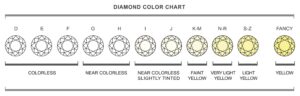
On this scale, stones classified with letters from D to F are considered “colorless” stones of greater quality and value. Proceeding in alphabetical order, then, we reach the letter Z which classifies a diamond with a particularly marked color, tending towards yellow and with a significantly lower value.
A totally opposite logic governs the evaluation of “fancy color” diamonds, which are those that present more or less intense colorations in shades of blue, green, red, purple, and intense yellow.
The colorations of these diamonds are due to the physical-chemical characteristics of the stones which, during the formation process, can incorporate particles of nitrogen or other chemical elements into their structure.
For these extremely rare diamonds, the more intense the color, the higher the price of the stone. Moreover, there is no real world price list or standard evaluation scale, but each stone is evaluated according to its specific characteristics.
And what about lab grown diamonds? What colors exist and how are they evaluated?
Exactly as with their natural counterparts, lab grown diamonds are also distinguished as “colorless“, evaluated according to the same D-Z color scale, and “fancy colors“.
To produce colored synthetic diamonds, just as in nature, specific chemical elements are introduced into the machine during the stone’s growth process, capable of generating the desired coloration. Among the chemical elements most used for creating fancy color synthetic diamonds are: beryllium (to obtain pink coloration), nitrogen (which gives yellow coloration) and boron (from which blue is obtained).
The secret to having the chosen color, then, lies in the attention to the type of impurities and integrated elements.
The clarity of diamonds
Another fundamental parameter for evaluating a diamond is clarity, that is, the more or less significant presence of inclusions within the structure of the stone.
During the formation process, whether natural or artificial, due to the high pressure and heat to which the atoms are subjected, it is possible for some imperfections such as cracks, cleavages, or crystalline formations to form. These inclusions can affect the brilliance and therefore the beauty of the stone.
To classify the clarity of diamonds, experts use a grading scale that ranges from IF (highest grade) to P3 (lowest grade).
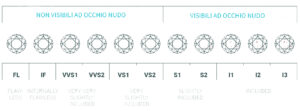
The first represents a diamond internally free of impurities, down to the lowest level where inclusions can be identified with the naked eye. Inclusions, in detail, prevent light from reflecting on the diamond. This is why a gem with a low clarity grade will be more subject to alterations in luminosity, appearing more opaque. Conversely, a diamond with an IF clarity grade will be much more brilliant and transparent.
The erroneous belief in the absolute purity of lab grown diamonds stems from the common perception that industrial control offers flawless results. Instead, the laboratory growth process is subject to variations similar to those that occur in the natural process. In this context, artificial diamonds can also present small inclusions or imperfections, as the process is not immune to such irregularities.
It’s important to understand that, despite laboratory synthesis, the absolute perfection of diamonds remains a relative concept, subject to the same natural influences that characterize diamonds extracted from the earth.
Which color and clarity to choose for our diamond?
Buying a diamond is never simple and is a delicate moment, both due to the large offer available on the market and the budget available. Lab grown diamonds offer a low-cost and eco-friendly alternative to classic natural diamonds, but since it’s an important purchase, it’s good to choose keeping in mind all the parameters we’ve talked about and some considerations.
Regarding color, even though diamonds classified with letters D-E-F are considered of higher quality (and are therefore more expensive), it is not always necessary to purchase stones with such a high rating.
In the first grades of the scale, in fact, the variation in shade is minimal and hardly perceptible to the naked eye. This is even more valid for small carat stones (below 0.30 ct, colors D-E or F-G are practically indistinguishable from each other).
Colorless diamonds that are positioned on the three highest grades of the evaluation scale are generally indicated to be mounted on platinum or white gold jewelry.
For yellow gold jewelry, even a stone classified as G-H-I can appear sufficiently transparent and colorless, as the contrast with the color of the metal will make the stone appear lighter.
Most major jewelry brands use F and G color diamonds, already considered high-level stones.
The choice of the diamond’s clarity grade can be based on similar considerations.
It is not necessary to spend very high amounts to have stones with FL or IF clarity (generally sought after by those who want to buy very large carat diamonds). Also in this case, a diamond with clarity between VS2 and VVS1 is already a stone of excellent quality and will guarantee you splendid brilliance, without visible defects to the naked eye.
Conclusions:
Thanks to innovative laboratory techniques, the lab grown diamond market is able to satisfy all desires: those who want a very bright and transparent colorless diamond or those who want to amaze with a stone with more eccentric or particular nuances.
Beyond the evaluation scales, necessary for an informed and thoughtful purchase, the only true rule is to follow your own taste.
If you are curious to discover more about lab grown diamonds and their availability, visit our e-commerce JW24